Grounded in Neuroscience, Validated by Evidence
The Science Behind Temporal Interference
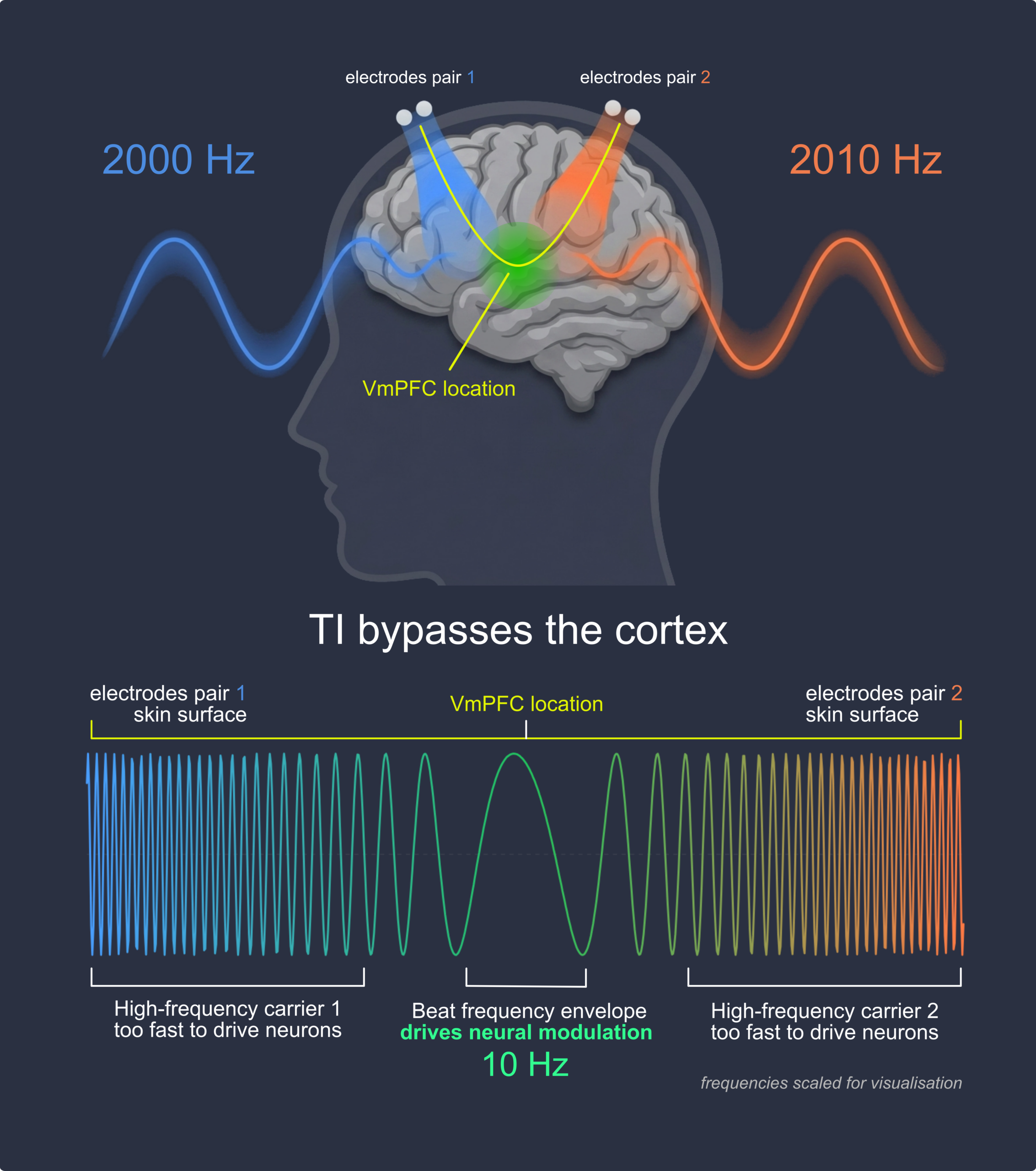
Temporal interference (TI) stimulation is based on a fundamental principle of wave physics: when two sinusoidal electric fields at slightly different frequencies are superimposed, they produce an amplitude-modulated envelope at the difference frequency. If two currents at 2000 Hz and 2010 Hz are applied through separate electrode pairs, the overlapping field at their intersection oscillates at 10 Hz — a frequency that can modulate neural activity.
Crucially, the overlying tissue only experiences the individual high-frequency currents, which are too fast to drive neural firing. This means the stimulation effect is concentrated at the target depth — enabling non-invasive, focal modulation of deep brain structures that were previously accessible only through invasive surgery or unfocused surface methods.
The vmPFC as Therapeutic Target
The ventromedial prefrontal cortex (vmPFC) is increasingly recognized as a critical hub in addiction neuroscience. It sits at the convergence of neural systems governing sleep, stress regulation, and reward valuation — the three pillars of AUD relapse vulnerability.
Sleep regulation: vmPFC lesions disrupt sleep architecture, while vmPFC modulation enhances slow-wave activity and subjective sleep quality. Sleep disturbances affect 60-75% of AUD patients during early abstinence and are among the strongest predictors of relapse.
Stress and arousal: The vmPFC exerts top-down control over autonomic stress responses. Disrupted vmPFC function in AUD leads to exaggerated stress reactivity — a core driver of craving escalation and relapse, particularly when compounded by poor sleep.
Reward valuation and craving: The vmPFC integrates value signals and modulates prefrontal-striatal coupling. Disrupted vmPFC connectivity predicts craving intensity and relapse. Naltrexone strengthens this coupling, but compliance limitations reduce its real-world effectiveness.
By targeting the vmPFC non-invasively with TI, it becomes possible to address sleep, stress, and craving through a single mechanistic intervention — rather than treating each symptom domain separately with different modalities.
Translational Biomarkers
A core challenge in neuromodulation research is determining whether stimulation actually engages the intended target and whether that engagement predicts clinical benefit. NeuroPrism’s approach emphasizes cross-species biomarkers that bridge preclinical mechanistic studies with human clinical outcomes:
Neuroimaging
Diffusion MRI microstructure and functional connectivity indices track alcohol-related changes and stimulation-induced restoration. These metrics are measurable in both animal models and human participants, enabling direct translational inference.
Sleep electrophysiology
Polysomnographic measures — N3 duration, slow-wave spectral power, sleep efficiency — provide objective quantification of sleep restoration. Changes in these metrics serve as both proof of target engagement and indicators of therapeutic benefit.
Digital biomarkers
AI-derived metrics from daily app interactions — craving trajectory patterns, mood variability, sleep quality trends — offer a new class of behavioral biomarkers that predict treatment response and enable early identification of patients who may benefit most from intervention.
AI Platform Validation
NeuroPrism’s AI mental health assessment has been validated in a multi-model evaluation published in Scientific Reports. The study compared three computational approaches — traditional NLP with advanced feature engineering, prompt-engineered large language models, and fine-tuned LLMs — and demonstrated that an ensemble combining all three achieves the highest classification precision.
The ensemble architecture achieves 93% precision on mental health status classification from text, outperforming any individual method. The multi-algorithm voting approach increases robustness by reducing the failure modes specific to each technique — ensuring reliable assessment even when individual models disagree.
Concurrent validity against gold-standard clinical instruments (including the Obsessive Compulsive Drinking Scale, Montgomery-Asberg Depression Rating Scale, and State-Trait Anxiety Inventory) and predictive validity for near-term clinical outcomes are being established through ongoing clinical studies.
Publications
AI and Mental Health
Kallstenius, T., Johansson Capusan, A., Andersson, G., & Williamson, A. (2025). Comparing traditional natural language processing and large language models for mental health status classification: a multi-model evaluation. Scientific Reports.
Brain Stimulation and Neuromodulation
NeuroPrism’s co-founders continuously publish on non-invasive brain modulation, temporal interference, and translational neuroscience. A full publication list is available upon request.