AI-Guided Temporal Interference: A New Approach
Two integrated technologies that address the shared mechanism of AUD relapse.
The AI Mental Health Platform
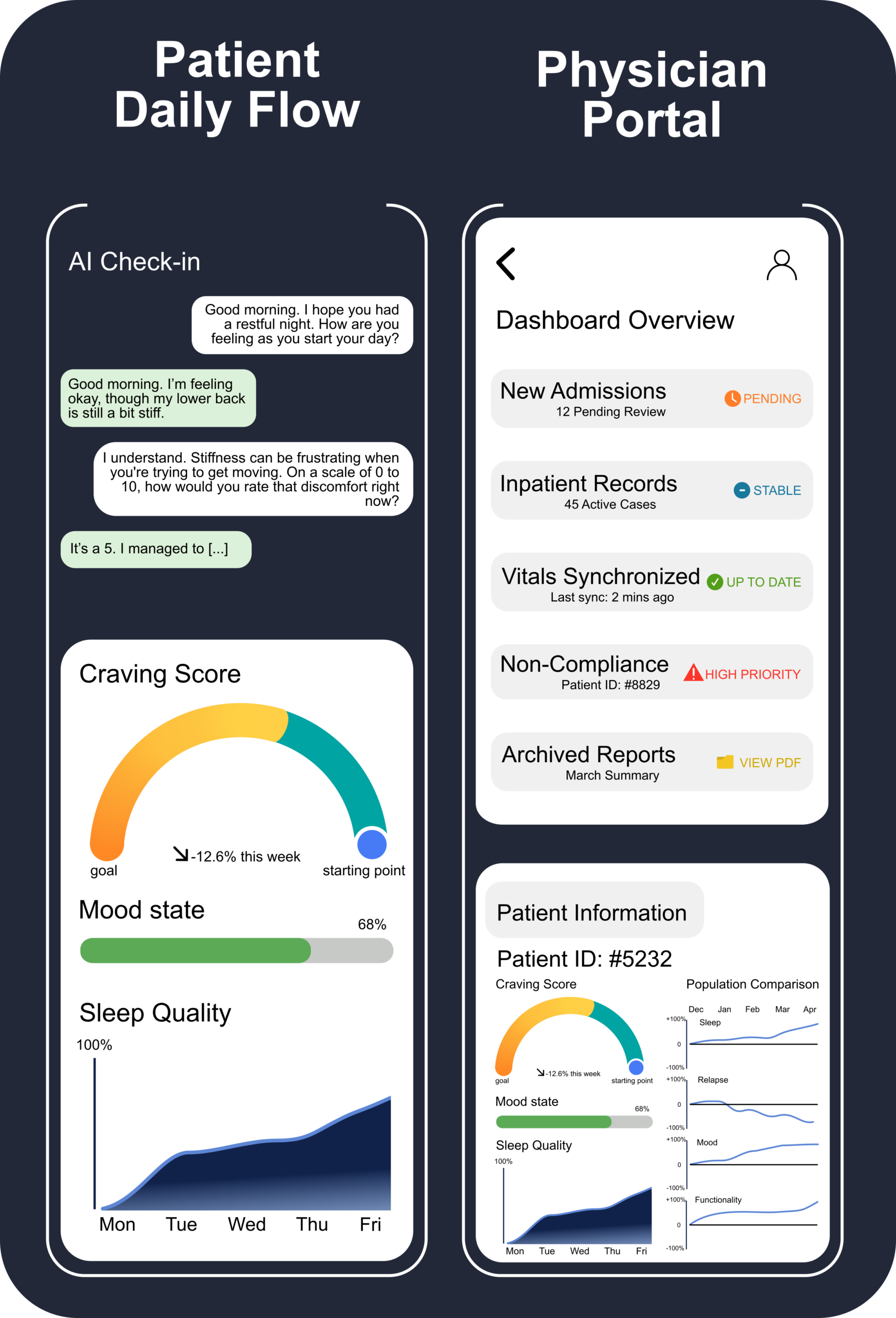
Traditional mental health assessment relies on infrequent clinical visits — leaving weeks or months of unmonitored time during which craving escalates, sleep deteriorates, and relapse risk silently builds. NeuroPrism’s AI platform changes this by providing continuous, between-visit monitoring through a patient-facing mobile app and a clinician-facing portal.
Patients engage in brief daily conversational check-ins through the app. Our ensemble of NLP algorithms — combining traditional NLP, prompt-engineered large language models, and fine-tuned models — analyzes these conversations to classify mental health states including craving intensity, mood, anxiety, and sleep quality with 93% precision, validated in our published study in Nature Scientific Reports.
Key capabilities:
For patients: Daily craving/mood/sleep tracking, progress visualization, motivational feedback, and early warning when patterns suggest escalating risk.
For physicians: Secure clinical portal showing all enrolled patients, longitudinal trend lines, automated risk alerts, and flags when intervention may be warranted — enabling proactive rather than reactive care.
Safety layer: Multi-tier suicide risk detection combining AI screening with clinician escalation protocols, ensuring patient safety is maintained throughout monitoring.
Temporal Interference Neuromodulation
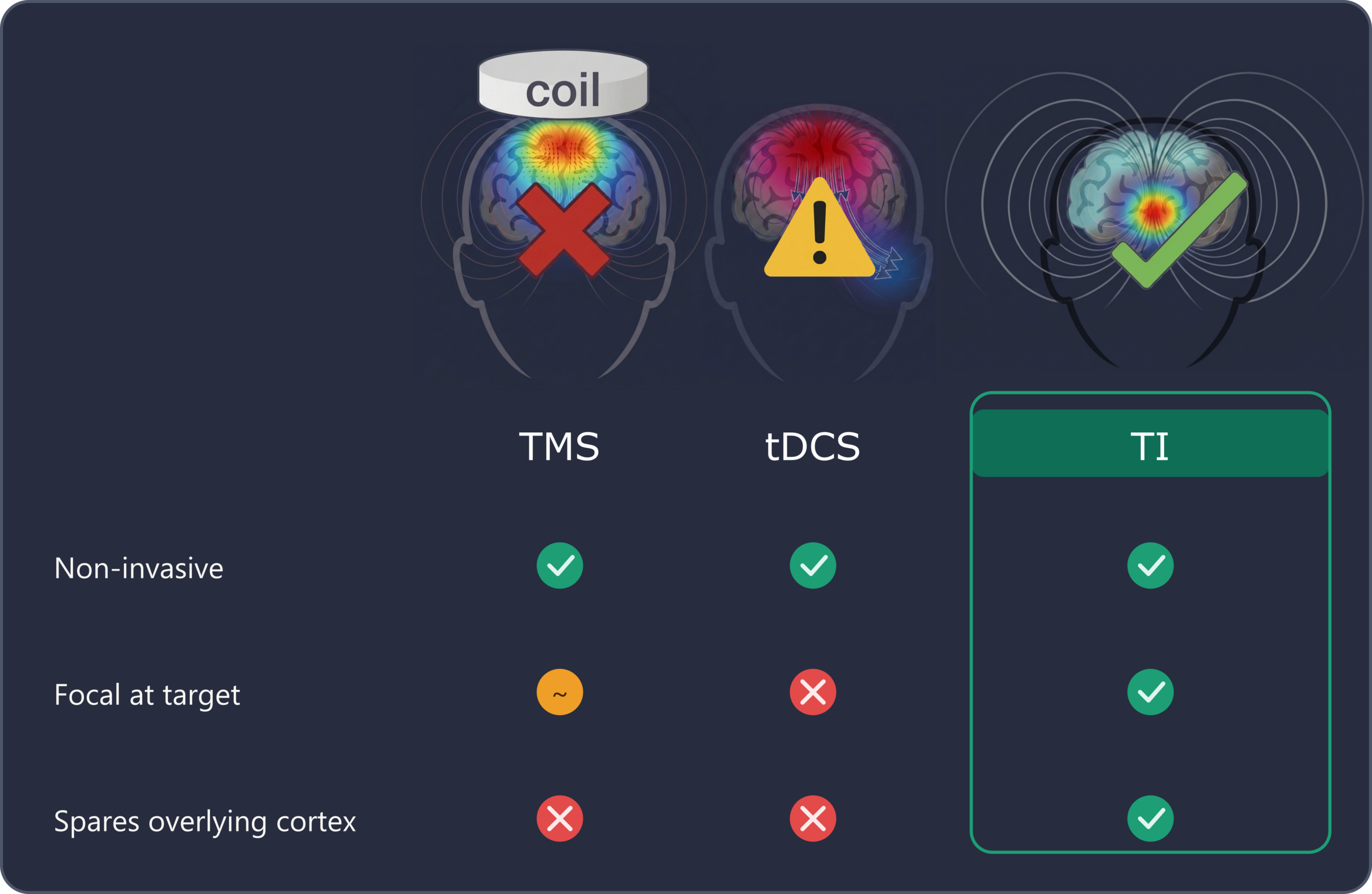
Temporal interference (TI) is a next-generation non-invasive brain stimulation technique that overcomes the fundamental limitation of existing methods: the inability to focally stimulate deep brain structures from the scalp surface.
How TI works
Two pairs of electrodes deliver high-frequency alternating currents at slightly different frequencies (e.g., 2000 Hz and 2010 Hz). Individually, these frequencies are too high to modulate neural activity. But where the two fields overlap deep in the brain, they create an interference envelope at the difference frequency (e.g., 10 Hz) — which does drive neural modulation. This allows precise stimulation of deep targets like the vmPFC while sparing overlying tissue.
Personalized via digital twins
Each patient’s brain anatomy is unique. NeuroPrism creates individualized computational brain models — digital twins — that simulate how TI fields propagate through each person’s head. These models guide electrode placement and parameter selection before stimulation begins, enabling safer, more precise, and more effective neuromodulation. Parameters are iteratively refined based on biomarker feedback.
Home-compatible
Unlike TMS, which requires bulky clinic-based equipment, TI uses compact electrodes and a portable stimulator. This makes it suitable for home use — patients can receive treatment nightly during sleep or during the day, without clinic visits. This dramatically improves scalability and adherence.
Dual treatment windows
TI can be delivered during sleep (targeting slow-wave enhancement and sleep restoration) or during wakefulness (targeting craving and cognitive control). This dual-track approach addresses both the trait-level vulnerability (chronic sleep disruption) and state-level triggers (acute craving) that drive relapse.
The Combined Approach
The AI platform and TI neuromodulation are not separate products — they form a closed-loop system where continuous assessment drives personalized treatment.
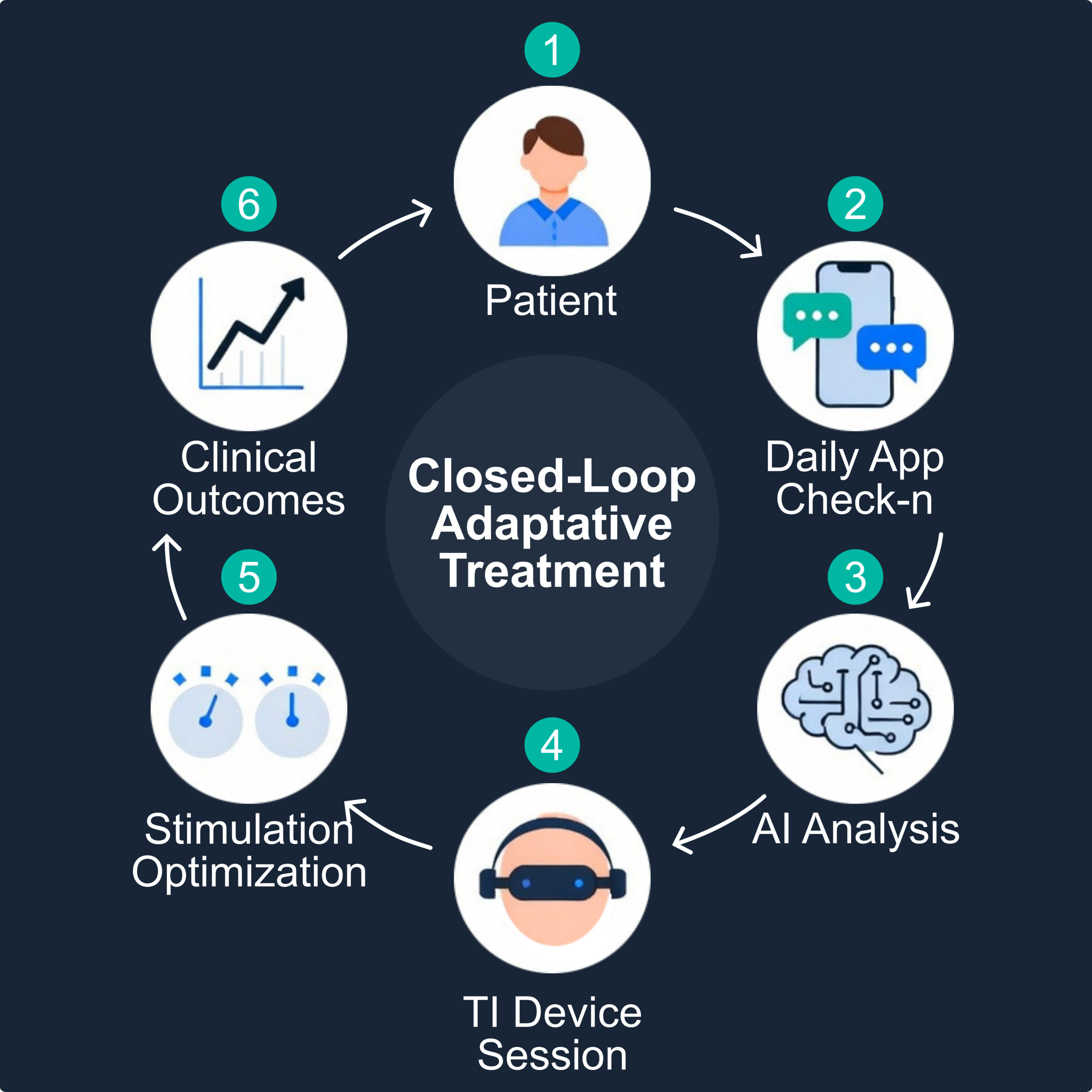
The AI continuously assesses each patient’s craving trajectory, mood, and sleep patterns. These data inform treatment personalization — enabling a future where stimulation parameters adapt dynamically to each patient’s evolving state, moving beyond one-size-fits-all protocols toward truly precision neuromodulation.